Wednesday, 30 March 2022

Some new Memes

 Who loves a Meme? Here's a few that we've posted on our social media profiles!


[If an Autistic person is non-verbal, still include them in conversations.
You may be surprised at just how much they are taking in.]


[Meet your child where they are developmentally here and now,
rather then be concerned by where medical or education
professionals say that your child should be.]


[Stop and admire the little things in life,
the tiny details that we miss through
being busy, because these can be the most
wonderous things.]


[Be so completely yourself that everyone else
feels safe to be themselves too. Unknown.]


[Normal is not a goal for me.
Normal isn't a compliment.
Normal is too much like playing tetris,
fitting in for the sake of fitting in.
O, 12 years.]


[Neurodiversity is....
A different way of thinking.
A different way of processing everything that an individual
sees, feels and hears in th3e world around them.
A different way of communication ones needs,
thoughts and wants.]


[Remember to choose the battles that you want to fight.
But also, for your children sake,
fight the battles that need to be fought.]

Sunday, 20 March 2022

Team Henry: Expectations versus Reality - Sleep

Our expectations

L struggles with sleep and has averaged roughly 4 and a half to 5 hours sleep a night since he was the age of 4 and a half months old. We were hoping that a Smart Pup would provide L with the level of comfort that he needs to fall asleep and stay calm. The plan was that L's pup would sleep in his bed so that when L woke in the middle of the night, he hopefully wouldn’t need us every night.
The Reality
We have always struggled to get L to 1. sleep in his own bed and 2. stay in his own bed.
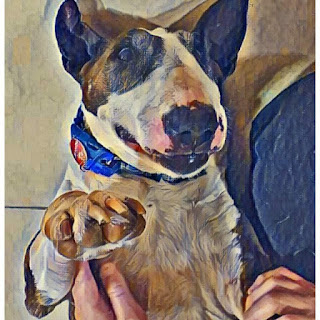
From the moment that Henry was placed, he has slept in L’s bed. The first month or so, L would last a few hours in his bed and then would come into us, with Henry following him.
Now, we are having more nights of L staying, not necessarily sleeping all night, in his own bed for the entire night. This is a first since L was a few months old.
And when L wakes up early because he longer needs to sleep, Henry goes with him. Prior to Henry, we would tag team so that we would have alternating good nights of sleep, so that one of us was always awake with L. Now he has Henry and is happy to lay on his bed playing on a device until the rest of the house wakes up.

Friday, 18 March 2022

Team Henry: Expectations versus Reality - Nuzzling

Our expectations

We were also hoping that the Smart Pup would be trained to touch, nudge or lay on L to disrupt repetitive or disruptive behaviours, in particular when L enters into meltdown mode he punches his own face and pulls his eyelashes out. We were hoping that the pup would be trained to disrupt these behaviours.


The reality
Henry was giving lap lays to L the afternoon that he was placed with us. Within the first week, Henry had begun to pick up on the cues that L was giving prior to entering meltdown mode and was stepping in, calming L before the meltdown had even begun. The deep pressure from Henry’s head and upper body on and over L’s lap is enough to calm L. Henry picked up on body cues, perhaps chemicals that L was releasing, that we missed every single time.
Henry has been trained to nuzzle L's face when he is in meltdown mode to disrupt L’s self harming behaviours of punching his own face and pulling out his eyelashes. L has since started rubbing his eyes when he is anxious or frustrated, Henry has picked up on this and now nuzzles L's face to disrupt this new behaviour. This nuzzling is enough to distract L that he stops and begins cuddling Henry.

Friday, 11 March 2022

Team Henry: The Why!

We're often asked why did we choose to apply to Smart Pups for an assistance dog for L.

We had a chance meeting with a Smart Pup who was still in training in mid 2019 – I can remember that the handlers said that the pup was to be placed with a boy who was Autistic and had epilepsy. We were at Northlakes Shopping Centre to watch a movie and prior to going to the cinemas, L had entered full blown meltdown mode. At that point nothing we said or did was helping him. Cue the entry of a Smart Pup. The handlers, who from memory were foster carers for the pup, asked if L would respond to the pup. The pup, not knowing L, was taken over to where he lay on the floor and immediately went through its training and calmed L within about ten minutes. It was truly remarkable to watch this young pup respond to a child that he didn’t know in the manner that he did.

For the remainder of the year, Scott and I talked about applying to the Smart Pup program as we saw the benefit that Ruby had on L and were hoping that a dog specifically trained for L’s needs would be extremely beneficial. We applied for the program in October 2019 and were accepted in November. The rest, as they say, is history.

Tuesday, 22 February 2022

When Choosing a Furry Companion


When choosing a Labrador, or any other furry companion, make sure that he (or she) has the standard described below....

- The Labrador does not walk; he/she trots! With a certain air of confidence and looking at the world from its immeasurable "height" while thinking ... “at what are you looking? Have you never seen such a beautiful creature as I am?”

- The Labrador does not run, but sprints like a rocket; he does not jump, but flies and bounces like a rabbit, or does zoomie helicopters!

- The Labrador doesn’t play. For him, a game is something to be taken seriously. Very seriously.

- When the Labrador sleeps, it cannot simply be said that he sleeps. He spreads on the sofa, becomes catatonic, reaches Nirvana ... and snores like a tractor!


- The Labrador never begs for food. He simply makes a gentle munching sound that announces what his belly demands. He stares at you while ribbons of drool run from his marshmallow mouth, accompanied by high-pitch sounds like a verse by a tormented poet.

- The Labrador does not need to talk. He commands telepathy, hypnosis, ultra-sensory perception .... and paws, should you fail to understand the previous prompts.

- When he eats, the Labrador does not just consume his meal. He/she devours it, gulps, swallows, gulps, and then looks at you as if to say, “it tastes fine, where’s the rest of it?!"

- The Labrador does not pass gas ... he /she gasses you to death!

- The Labrador does not wag its tail, but he waddles, or more precisely, "he shakes his behind"! It doesn't follow you .... the Labrador is the most obsessive of stalkers. The Labrador never follows you; he tracks your every movement with the precision of a secret agent.

- The Labrador has a relationship with you that is not simply one of affection ...no, he is not close to you. He is a part of you. The Labrador does not run towards you, but he invests you! He claims you in an exuberant fashion!! When you pat him, he’s in ecstasy and slips effortlessly into a land of contentment , usually at your feet.

The Labrador worships, adores, idolizes and loves you as only a Labrador can. That is his sole purpose in life.
The exact same can be said for any furry companion ❤

Saturday, 12 February 2022

Containers for Change

As most of you know, Henry was placed with us in May last year and he has made such a huge positive influence for L, but also for O.

So much that we're going to start fund-raising again, but this time for an Autism Assistance Dog for O.

Rather than use Smart Pups (which are just amazing,) we're hoping to use a different local based organisation that will train O how to be the handler, and the pup at the same time. We're yet to find the perfect puppy, but we're wanting to start the fund-raising journey.

Unfortunately there is no government funding that is allocated to training Assistance Dogs for children, so it's up to the families to raise the money.

The total amount for Henry was close to $35000 - this covered the trainers wages, the training for Henry as well as food, equipment and everything else that he needed, and the costs involved in certification of an Assistance Dog. We're not needing to raise nearly that much for a pup for O, however the cost for Public Access Test is going to be at least $750.

So if you are able to collect cans and plastic bottles, and would like to donate the profits to funds for O's assistance dog, we'd be much appreciative.

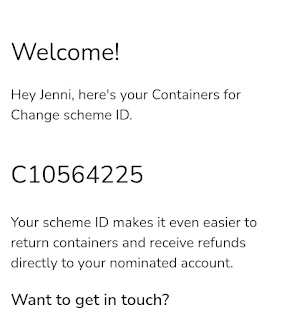
We've created a scheme ID with Containers for Change so that if you are able to, the money raised from the cans can be deposited straight into the account for O's pup when you take the containers to the drop off point. This scheme ID is valid in both Queensland and Western Australia.

If you've read this far, thank you so very much ❤

Thursday, 3 February 2022

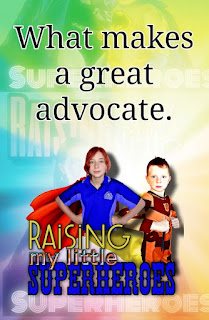
What Makes a Great Advocate?


The moment that we received L's, and then O's, Autism diagnosis, Daddy Superhero and I started on a new journey - becoming advocates for our little superheroes. We could have easily employed the services of an Autism advocate but we know our little superheroes the best.

Being an advocate means that I am assisting my little superheroes to access the services and support that they need both at school and in the community. Until they find their own voices to self advocate, I am their voice.

As I have mentioned in a previous post, being an advocate for my little superheroes is very rewarding but it is also hard work at times. Being an advocate can take you out of your comfort zone if you do not feel confident in speaking up for another person.

Families are generally the best advocates for their children but at times, parents may not physically have the time to attend meetings for their children or they not feel comfortable with the idea of any potential confrontation. If families are also on a learning journey with their children, they may not feel confident in knowing what supports that they should request for their children.

So if you are not confident in being your own or someone else advocate, what qualities should you look for in a great advocate?


Ultimately, advocacy is about speaking on an individuals behalf, and supporting the best interests of an individual while promoting and protecting the individuals rights.

Not all advocates are the same - the role that they play will vary according to any training and study that they have undertaken, their experience in both an advocacy role and with Autism as a whole, and they may have expertise in different areas (education, social, with different disabilities and so on.) 

Anyone can assume the role of an advocate, but the strongest advocates are those who have a direct relationship to those who they are advocating for. That relationship could be that they are a relative of the individual or it could be that they have direct experience with the individuals disability.

In regards to an Autism advocate, the individual should understand and know that Autistic individuals are capable and bring enormous value  to their community. An Autism advocate should know and understand that all Autistic individuals are unique from the next. That the supports that suit one Autistic individual may not suit the next.

A great advocate will want to assist you to become, and assume, the primary advocate role in your child's supports. Through assisting you to advocate for your child, they should provide you with the skills to begin feeling confident to advocate effectively for your child.

They won't make the decisions for you, rather they will assist you to become well informed about your child's needs. They should assist you to consider and weigh up the best options for your child. A great advocate should empower you, and your child, to make the best decisions for your child.

A great advocate should be able to investigate and explore alternative support services for your child. They should be familiar with local therapy services that are available and that would suit your child's needs. They should also be able to point you in the right direction of support services for yourself as a carer.

A great advocate should listen, truly listen, to you and your child about what their needs are, what their goals for the future are and any skills that your child would like to improve on or develop. 

Advocates can be the important link between families and service providers. A great advocate should maintain a professional, respectful and collaborative approach when meeting with yourself and your child, as well as when they are engaging service providers on your behalf. They must be able to communicate with strength and clarity so that needs of your child are met.

When you meet with any potential advocate, you need to feel as though you are connected with them. You will need to have trust and confidence in your chosen advocate that they have your child's needs in mind at all times when they are performing their role. Don't be afraid to meet with several potential advocates prior to engaging them as an advocate.

And above all, trust your gut instinct as sometimes this tells us more about how we feel about some one than any information they give us.