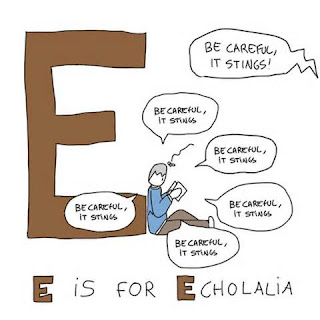
Showing posts with label Echolalia. Show all posts

Saturday, 8 January 2022

Echo, echo, echo, echo ......


L was non verbal up until he was three. Prior to using verbal speech to communicate, L used a combination of sounds and key word signing to communicate.

L was able to say a few words that he knew and used on a daily basis. There were also others that he used but it was communication through EcholaliaEcholalia is best described as repeating phrases and words after an individual has heard them.

L also used, and still does, Scripted Speech, which is repeating parts of speech that he hears in movies, TV shows and even in general conversation. Often scripted speech is used to express an individual's emotions. They may a particular phrase when they are experiencing an emotion and then on future occasions, will say the phrase as it reminds them of that emotion.

For Autistic individuals, that may also use scripted speech in play - they may act out particular scenes from movies or television shows that we watch, verbatim.


This is one of the phrases that he'll say. But I've recently realised that I too will repeat phrases that I've heard. I will these phrases when it is appropriate and in particular situations. I don't consciously say these phrases, I just find myself saying them.

Like "You're welcome!" from Moana, when someone says thank you to me!

"We're going to need a bigger boat." (Jaws)

"To be faiiir!" (Letter Kenny!)

"Tell him he's dreaming." (The Castle)

"That'll do pig, that'll do." (Babe)

"Round up the usual suspects!" (Casablanca) - when we're organising the little superheroes to go somewhere!

"Houston, we have a problem." (Apollo 13)

"Just keep swimming." (Finding Nemo)

"Ogres are like onions!" (Shrek)

"Roads? Where we're going we don't need roads." (Back to the Future.)

No matter how an individual communicates, please listen to them and respect them ❤❤

I'd love to hear the phrases that you find yourself saying.

Sunday, 12 May 2019

What are other traits associated with Autism?


Earlier this year, I was asked to present at a professional development session for early childhood educators. The presentation? All about Autism and Sensory Processing Difficulties.

The presentation was received so well that I thought that I would use part of my presentation on my blog as I'm often asked questions about Autism and O and L. So here goes!!

This is part four in which I have been discussing different aspects of Autism. The first three parts of this series focused on The Triad of Impairments. You can access Part One here, Part Two here and Part Three here.

As well as the Triad of Impairments there are other traits that are often associated with and seen in individuals who have been diagnosed with Autism. Before I go on, please keep in mind that many of these traits are seen in typically developing children, the difference is the intensity in which the traits present. I'll be referring to children who have been diagnosed with Autism but many of these traits are also seen in adults who have been diagnosed with Autism.


Children with Autism, at times, don’t notice when or understand why, another child is crying, has been hurt or when they hurt someone’s feelings. It isn’t because they lack the capacity to have those emotions, they have a developmental delay in that area. Likewise, some children with Autism are not aware when they are smothering other children with affection. This isn’t deliberate, they are not aware that other children have had enough.

L still struggles to understand when and why others, including us, are sad, upset or angry. Hugs are definitely on L’s term! O on the other hand still needs to be reminded that other children, including her brother, do not like extra long squishy hugs even when they are trying to push her away.

Children with Autism are prone to over the top emotional outbursts – meltdowns – and these can and do occur on a regular basis and can be very, very intense. Meltdowns can occur when the child is experiencing sensory overload, when routines are changed, when they are in physical discomfort, when they are stressed and due to many other situations. A meltdown may occur for no apparent reason and may be unexplained. 

During a meltdown the child may lash out at those nearby, they may thrash their body around, they may say things to those around them, they may scream and shout or they may just sob uncontrollably. During a meltdown, a child is not in control of their body and often they will have no recollection of what they did or said once the meltdown is finished. During a meltdown, you will not be able to reason with the child as they physically can not hear you. The best thing that you can do during a meltdown is be nearby for reassurance and to ensure that the child doesn’t injure themselves.


The pain threshold in children with Autism can vary from very high to very low. Those with a very high pain threshold are simply not aware that they should tell a parent or carer when they are injured or sick. L’s pain threshold is super high to the point that in 2017, we stopped counting at 17 different incidents that he did to himself through play or exploring his environment. These ranged from sticking objects in his ears - we're up to the count of 5 different occasions -  a concussion and possible skull fracture from falling out of the school bus on the first day of school, getting his head stuck in a toilet seat, getting his fingers stuck in a science toy, he had a permanent lump on his forehead for about 8 weeks when he kept hitting it in the same spot accidentally over and over, he’s knocked his top two teeth out, he has impaled a garden hoe between his toes and many others. L makes life interesting. His catchphrase is now “I’m okay, there no blood!” and he now has a favourite nurse and is known by name in the accident and emergency departments and ENT departments at four hospitals in two states of Australia!

Many children with ASD are unable to differentiate between hot and cold temperatures. You’ll be able to easily recognise these children – they’re the ones wearing winter clothes all year round or they will be butt naked all year round. L does not feel the cold and if we let him, he’d get around in a pair of jocks in winter. His all-time favourite winter onesie is a Pikachu thick onesie. During summer, this gets hidden from him.

Many children with ASD have little to no awareness of safety and/or danger and seem to be fearless. They will do things that even adults will shake their heads at. They may run off from their parents or carers. They don’t do this deliberately – quite often it is to get away from a sensory input or they will see something that they want to look at and it will not occur to them to tell an adult where they want to go.

Many children with Autism may struggle with complex multiple step instructions. Their brain will hear the first step, process what that step involves and by the time that they have completed the first step, they’ve forgotten the rest.

In many cases a child’s processing time will be much longer than that of their peers. They may not answer you or respond to you straight away as their brain is processing what you are saying or asking of them.


Children with ASD may be prone to “w” sitting. W-sitting describes when a child is seated on their bottom, with their knees bent and legs splayed out to their sides in what looks like the letter "w.“ Children with ASD will often prefer a w-sitting position to sit in as opposed to other more challenging and tiring positions. The reason for this is that when seated in a w-sitting position a child does not need to engage their abdominal muscles. When seated in the more conventional cross-legged position, a child must engage their abdominal muscles to stay upright. Sitting in a w-sitting position provides a very stable base for the child's trunk and hips and therefore allows a child to move easily to play on the floor. However, the movement is generally in a forward and backward motion as opposed to moving and turning from side to side. 

One of the issues with the w-sitting position is that it does not allow or permit a child to perform trunk rotation, or twisting and turning, and lateral weight shifts, side to side motion, to reach toys on either side of the body. The development of trunk rotation and weight shifts over to one side and to the other is vital in children as both assists in maintaining a child’s balance while running and walking as well as when climbing and playing on play equipment. It is also necessary for being able to cross our mid-line when writing, drawing, turning pages on books, dressing themselves and other similar skills. Sitting in a w-position on a long term basis may cause orthopaedic issues in a child's hips, knees and feet as well as tightness in the leg and hip muscles.

Sleep disturbances and sleep disorders are quite common among children who are on the spectrum. It is unclear why but one train of thought is that children with Autism simply do not produce enough Melatonin. Melatonin is a natural hormone that is produced and secreted in our bodies by a very small gland found in the brain. During the day the pineal gland is inactive, however when the sun begins to go down it is kicked into action and Melatonin, or the Dracula of Hormones is released! 

Melatonin is important in helping to regulate our circadian rhythm or our internal body clock, and regulating our cycle of sleep and wakefulness. Melatonin levels in our body vary in our twenty four hour cycles. Normally our bodies production of Melatonin is reduced by simply being in bright light and the levels increase at night time. We have receptors in the back of our eyes that when they receive light, they send a signal to the pineal gland which then suppresses the production of Melatonin. When natural light decreases, Melatonin levels are gradually increased and they remain high while it is dark. When the receptors are again exposed to light in the morning, Melatonin production is suppressed and our Melatonin levels drop.

There are many other traits that may be seen and are associated with Autism. Not all individuals diagnosed as ASD will exhibit these traits and no two individuals who have been diagnosed with ASD present the same.

Autism really is a spectrum!

Monday, 7 August 2017

How does one communicate when the world can be confusing?


Up until his third birthday L spoke a grand total of roughly 20 words. A typically developing three year old, should have a repertoire of roughly 200 words. L was missing quite a number of words from his repertoire.

Whenever we mentioned this to L's child care Educators or to medical professionals, they would defute what we saw with "no look, L can say more than that, watch, L say ...." and he would be able to repeat the word to them.

However the words that they were getting him to repeat were not a part of his everyday vocabulary.

So how does one communicate when the world can be a very confusing place?

Children with ASD generally find other ways of communicating their needs and wants. They have their own unique way of communicating and L was no exception.

Through L's autism diagnosis we were able to identify the many ways in which L was communicating with us and others, at the time we just did not know that they were all autism spectrum disorder traits.

So I thought that I would write a post detailing the many ways in which L used to, and still does at times, communicate his needs and wants.


Key Word Signing

Key word signing or Makaton is a simplified version of Sign Language and as the name suggests, the actual signs just represent words. When signing the word, you also need to speak the word so that the child begins to make the connection between the two. Key word signing isn't intended to replace the need for speech, it is used to assist the development of speech.

L picked up key word signing from a very young age and it was truly wonderful to see his frustration at being unable to communicate ease a little. At first L picked up the signs for please, more, finished, eat and drink. He would never say the word but the signing action was very clear.

I have used key word signing for children with special needs, children for whom English is their second language and for babies and have had great success with all groups. Key word signing is a very effective communication form and it really does alleviate a child's frustration at being unable to communicate.


Non-Verbal communication.

From an early age L also used a series of sounds, grunts and random hand gestures. He would point at a direction that he wanted to go in or at an object that he wanted. The sounds and grunts that he used, while they did not resemble words at all, they all had a meaning. O became an expert at being able to interpret L's communication form for us!

In the ASD world, non-verbal does not mean quiet!


Echolalia

Quite often if we or anyone else asked L a question such as "where are your shoes," L would answer with "Where are your shoes? Dunno."

But again L would never repeat the words voluntarily. They were only ever repeated after hearing a statement or being asked a question.

Echolalia describes the act of a child or individual repeating verbatim what you have said or asked prior to answering the question or carrying on the conversation. In effect, echolalia is the repetition of the speech of others and it is generally a consistent trait among individuals diagnosed with Autism.

Echolalia is a very normal way of learning to communicate and most children at some stage in their development use this form of communication to learn to speak. If you listen to babies babbling, it is usually done in a rhythmic way. A baby will mimic the cadence of their parents or carers speech. As their speech continues to develop, a young child will copy sounds, words and sentences that they hear adults and other children say.

So echolalia can be described as an attempt to communicate to others, to learn new language and to practice new found skills.

Most children tend to grow out of using echolalia speech, individuals on the spectrum generally do not. L was still using echolalia speech well after turning three years of age and he still uses it occasionally.

Another reason that has been explained to us for L using echolalia was to give him time to process what he had so that he could retrieve a memory on how to answer the question.

Mimicking the speech of others.

Another form of echolalia is mimicking what others say. When L was asked as a toddler to say a specific word, he was merely mimicking exactly what he heard.

L could say other words by simply copying what he heard. His speech wasn't very clear but he could repeat the word.

However the word that he repeated was never said voluntarily.


Scripted Speech

Scripted speech is another form of echolalia but it describes the act of repeating verbatim phrases or words that an individual has heard from interactions with other people or from television shows or movies often during completely random moments or for children during play.

Scripted speech is a facet of autism that fascinates me and it is something that both L and O do on a regular basis to this day. Quite often L and O will repeat entire sections of movie or television shows while they are playing and usually in the accent that they heard it in. Quite often the scripted speech will be during completely random moments! The accents that they both come out with are astounding!

What O and L repeat never changes from one play experience to another and it seems to be an ongoing action. I'm not sure that either L or O will outgrow this form of communication.

What? What did you say?


Quite often when you ask L or O a question or ask them to do something, they will respond with "what?" or "what did you say?" or "can you repeat that please?"

Quite often individuals with autism struggle with processing what they have been asked and as such it can take them a little longer to respond.

When L and O initially respond with "what" or "what did you say," we simply repeat exactly we have said. Quite often L and O are then able to respond appropriately to our request.

By answering with "what," they are processing what we have said and again retrieving a memory on how to respond. It's not that they are being rude, they just need a little extra processing time.


Communication Boards.

L has also used basic communication boards to communicate his needs and wants. A communication board consists of different symbols that represent a variety of words and/or phrases.

The communication boards do not replace the need for speech, again they are used to assist in the development of speech. While pointing to the symbol or picture, it is recommended that the word be said as well so that the child begins to make a connection between the symbols and the words that they represent.

There are many others ways in which individuals can communicate, these are just a few that L and O have used or still use.


So the next time that you are struggling to communicate with a child and they are responding in a way that you do not understand or seems frustrating to you, take a  step back and look at the bigger picture.

Is the child not communicating effectively or are we looking at their communication form from the wrong angle?