Showing posts with label Autism is for Life. Show all posts

Thursday, 9 May 2024

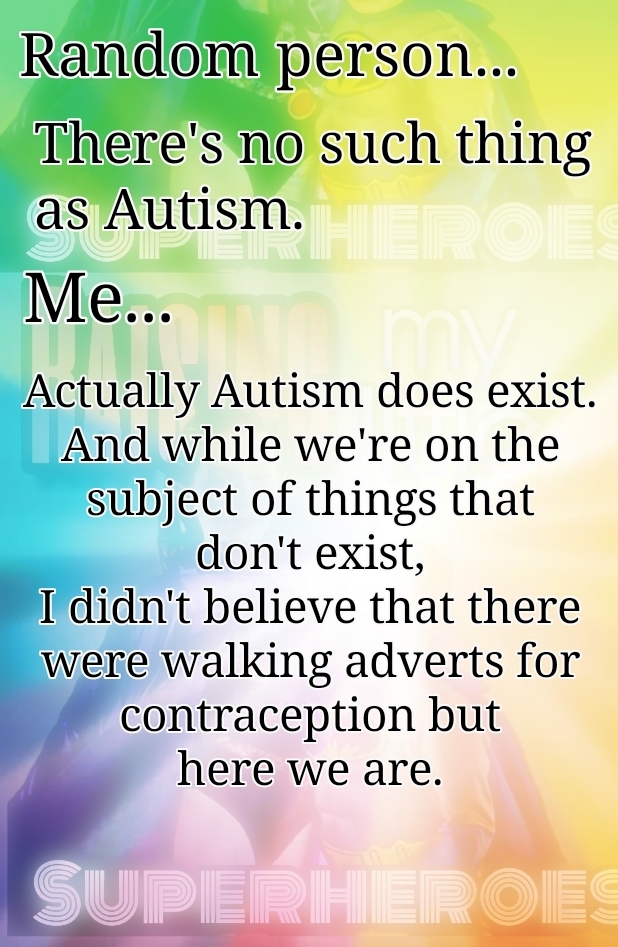
We're NOT all Autistic.


Oh but we're all a little bit Autistic."

Hmm, if you are Autistic, I'm guessing that you've heard that phrase or statement, or something very similar to it, at some stage from well meaning friends, family, colleagues or even from random strangers. Maybe even from a medical professional.

It honestly amazes me how often we hear this. At least once or twice, sometimes more, a week, someone tells me "oh but we're all a little bit Autistic." So far this week alone, that phrase has been said to me three times - once from a parent of an Autistic young adult. And depending on who says it, and how it is said, it really grates on my nerves.

Why does it grate on my nerves? Because we're not all a little bit Autistic.

Welcome to my unofficial TED talk on why we're NOT all a little bit Autistic.

At times when we hear that phrase, it's followed by, "but all children do that," or "I fidget," or something similar.

There are many Autistic traits, many of which can be seen during typical childhood developmental stages. For instance, toe walking. Babies and toddlers will often toe walk when learning to walk. But your typically developing child will outgrow toe walking. An Autistic child may toe walk for longer. Many Autistic adults toe walk.

Echolalia is another trait - the repetition of phrases or words. Listen to babies babbling. Often babies, and toddlers, will use Echolalia like speech patterns when learning to communicate. But a typically developing child will outgrow the echolalia speech patterns.

Fidgeting. Yes we all do fidget. And anyone who says that they've never fidgeted is telling porky pies. You might fidget because you're bored during a work meeting. You might fidget if you're nervous or anxious about an upcoming appointment. Fidgeting may look like tapping a pen or pencil, tapping your foot on the ground, playing with your finger nails, drawing random objects in the margins of your work books or diary.

For the neurotypical, ie non-Autistic, person, once you're out or away from that environment, the fidgeting stops and it no longer interrupts your day.

For an Autistic individual, stimming - aka fidgeting - is a part of their daily life. Every single day. Stimming is used to express emotions. Stimming is used to ground and self regulate emotions. Stimming is used as a tool to distract from the external over whelming sensory input.

For an Autistic person, stimming is a part of life. I carry sensory items in my pocket every single day just in case I need them. Up until recently, I didn't realise just how many times a day I use these items to self regulate my own emotions and to distract myself from sensory overload. And thinking back on it, I have always carried a small sensory item in my pocket during my adult life so far. One of those big aha moments.

Sometimes stimming is a welcome distraction. Other times, stimming can be detrimental especially if it is a self harming stim. For an Autistic individual, escaping from the environment does not mean that the stimming stops. Stimming is classed as a restrictive and repetitive behaviour, ie it occurs all the time and can impact their daily life.

I could go through all of the Autistic traits and criteria that are used to diagnose Autism, but we'd be here for days. So I'll move onto other reasons why we're not all a little bit Autistic.

If everyone was a little bit Autistic, the world be a much friendly sensory and social environment for everyone. Our world is set up for neurotypical individuals. Schools, shopping centres, attractions, hospitals, pretty much any place you visit, are not created with Autistic individuals in mind. Many of those places are a huge sensory nightmare.

"Oh but shopping centres can be very busy." Yes they can, especially around peak times throughout the year. But a simple shopping outing to buy groceries during an off peak period, can be socially and sensory overwhelming. For both my children, it's often the choices that are available. For example, buying a snack. They know they want a snack but there's so many choices. They may initially have a snack type in mind but then as soon as they see the other choices, their brains go into overload. It's then not a simple choice, and we'll often walk away with no snacks and with children who are feel overwhelmed and bombarded.

If we were all a little bit Autistic, the world would be much more inclusive of neurodiverse individuals. And let's be completely honest, the world really isn't truly accepting of differences and therefore not truly inclusive. Often in workplaces, Autistic individuals have to request and justify why they need accommodations. If workplaces were inclusive, Autistic individuals would not need to justify why they need certain accommodations simply to do their role.

If all children were a little bit Autistic, education settings would be created to suit all learning types. This definitely doesn't occur. As it is, all children (regardless of neurotype) learn in a different way, yet learning materials and assessments are standard for all. Individual Education Plans (they may have a different term depending on where you live) are created every school year to assist Autistic students to access a quality education that suits their learning style. And unfortunately these IEPs aren't always suited to the students changing needs.

None of things exist for Autistic individuals.

Autism is a neurotype. You either are or you aren't Autistic. It's not half and half. An Autistic individual doesn't choose when and where they're going to be Autistic.

It isn't a compliment to tell an Autistic individual that everyone is a little bit Autistic. Saying this implies that you are discounting everything that the Autistic individual has gone through to gain the diagnosis. You're discounting their struggles that they may hide every day. You're discounting the affects of Autistic masking. You're discounting the efforts that the Autistic individual maintains to navigate their world.

So please, please stop telling Autistic individuals that "we're all a little bit Autistic." Because one day they may respond with, "and we're all a little bit ignorant, let me re-educate you!"

And if you think you are a little bit Autistic, go and get an Autism Assessment done. Then you may just realise that no, we're not all a little bit Autistic. Because gaining an Autism diagnosis is another barrier for many people.

Friday, 3 February 2023

The Yogi Awards: Team Henry

What an exciting start to 2023 for Team Henry! 

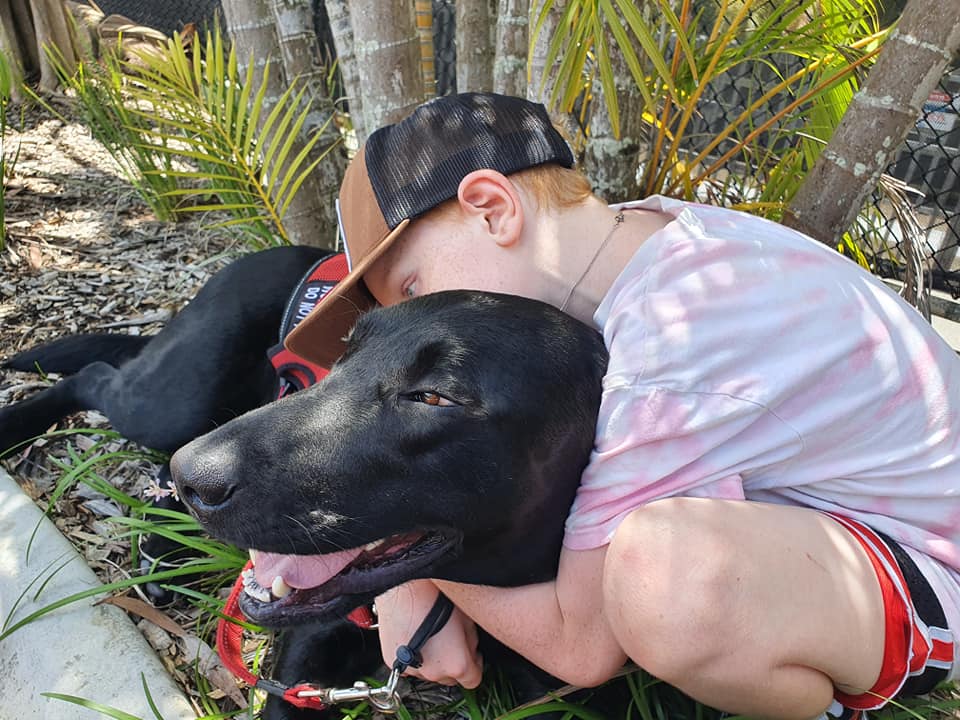
Late last week we received an email that said that not only had Team Henry, aka Henry and L, had been nominated for the Yogi Award, but also that they were receiving a medallion for Courage, Resilience and Determination. In other words they are being awarded the Yogi Award!

The Yogi Award is an annual award that is run by Animal Therapies Limited. The award recognises the power that human animal interactions have in the journey to greater wellbeing for the human member of the team. The award recognises the courage, resilience and determination that the team displays every day.

This year the award is going to be presented at the 2023 Animal-Assisted Services Conference here in Brisbane.

To say that we're super proud of Team Henry is an under statement.

Henry is just amazing and L has come so far with Henry by his side. L shows Courage, Resilience and Determination every single day.

Usually there is only one overall winner of the Yogi Award, however this year we will be sharing the spotlight with another young assistance dog team - Team Whoopi and his child Erika-Bela.

So very proud right now ❤️❤️


Saturday, 12 November 2022

Team Henry: Expectation versus Reality - So much more than just an Assistance Dog!

As well as being L's Autism Assistance Dog, Henry assists L in many other ways!

Shopping trips used to be a nightmare for L – the sensory overload from shopping centres is enormous. Now, they are a breeze with Henry by L’s side. Anytime during a shopping trip that L, and at times O, begins to feel overwhelmed, he and Henry find a spot to have lap lays and cuddles. Prior to Henry, shopping trips usually ended in a meltdown. We haven’t had one meltdown while out shopping. Even Christmas shopping was an easy outing.

Haircuts. L has naturally curly, think ringlets, hair but due to his sensory processing difficulties, he dislikes his hair being brushed so regular hair cuts are a must. As L doesn’t like people touching his hair or head, hair cuts are a sensory nightmare for him and can take up to a few hours for a simple trim. Now with Henry, a haircut takes less then 20 minutes. Henry is a bit of a hit at the barbers too and no longer munches on the hair treats on the floor!


Hospital and medical appointments. Even though we are on a first name basis with the medical staff at four emergency departments, L struggles with hospital visits and medical appointments in general. Henry has been a godsend and each time we’ve had an appointment or a visit to the emergency department, L has been able to stay calm. He still reverted to being non-verbal, but he was calm.

Lockdowns, isolation and flooding! Well, what can I say. The last few years have been a challenge for everyone. The first few lockdowns prior to Henry were a real struggle. But having Henry to help L, and O, to self regulate has been awesome. So far, because goodness knows what is going to happen in the future, we have been through one covid lockdown, three covid isolation periods and the February flooding, with no meltdowns. Henry is so super calm, that he causes both little superheroes to remain calm.

Family outings have always been tricky for both little superheroes. Prior to Henry being placed, our family outings wouldn’t last more then a few hours and they were usually to the same places so that both kids wouldn’t become too overwhelmed. If we were even thinking of going to a new place, we would have to give both kids at least a weeks notice so that we could prepare them for the outing.

Since Henry, our family outings have become much easier, more frequent and have become longer. We’ve become more adventurous and have visited places that we haven’t been to previously. We’ve done a few surprise outings, which we could not have done prior to Henry being placed.

Australia Zoo was our first successful outing. We lasted roughly five hours and the only reason we left is due to both kids complaining of sore feet. Neither entered into sensory or emotional overload. I may have become teary later that evening because of how amazing Henry was. 

We've visited two of the theme parks on the Gold Coast in one day - this is something that we couldn't have done before Henry.

Now when we are on outings, if either of the kids begin to feel overwhelmed, Henry steps in with lap lays, overs and nuzzles. And not once have we had to end an family outing early due to one of both kids becoming overwhelmed. Sealife on the Sunshine Coast, a full day school excursion for L, a full day at the Gold Coast Supernova convention to name a few, all have gone exceptionally well.

Even a simple outing such as Santa photos was near impossible prior to Henry being placed. Our 2021 Surfing Santa photos were a breeze for L and we had to constantly remind him that we had to leave!

L is responsible for looking after Henry on a daily basis, under our supervision of course. He feeds Henry, brushes him, picks up Henry’s poops, plays with him, helps to wash Henry and everything else in between. This is developing L's skills a whole range of areas.

Henry is L's furry sidekick and as long as L always needs him, Henry will be by his side.

Friday, 19 August 2022

We need to chat!!


Let's have a chat about this!!

It seems like every month, nay every week, yep it happened again yesterday, that someone says the dreaded words "I just can't see their Autism," or a different version of it.

This statement is not okay to say to anyone - unless you are a walking MRI machine. And unless we have some android humans walking among us, this just isn't possible!

Saying "I just can't see their struggles," or "They don't look Autistic," or "Are you sure they are Autistic?" or any other version of this statement, you are implying that you don't think or believe that my children are Autistic.

It isn't a compliment. It isn't polite.


You are, in fact, questioning their ASD diagnosis. You are also failing to recognise that every Autistic individual is unique. You are also dismissing all of their struggles and the obstacles that they have overcome to get where they are today.


If you have an idea of what Autism is meant to look it, how an Autistic person is meant to behave, how they should sound like, please do a data dump from your brain, and get to know the Autistic individual that is in front of you.

There is no one look to Autism.


As the saying goes, if you've met one Autistic person, you've met one Autistic person. 

If you've taught one Autistic student, you've taught one student.

Every Autistic individual is different in their own way.

Saturday, 13 August 2022

Independence: Learning about Money

*** Please note that we do not receive commissions of any kind in regards to this post. The product mentioned in the post is simply a product that we have found useful. ***

In raising children, regardless of if they are neurodiverse or neurotypical, all parents just want their children to learn the skills to become independent as an adult - well that's what we want anyway!

One of the skills that Daddy Superhero and I are constantly teaching both little superheroes about is money handling skills.

As with most children, both little superheroes struggle with the concept of money - how to earn money, spending money, budgeting and saving money, and the fact that money doesn't grow on trees! 

A few years ago we introduced the concept of superhero bucks, and while both little superheroes seemed to grasp the concept, the superhero bucks just wasn't teaching them the budgeting skills that they both need to learn.

Early last year, we purchased a game called "Pocket Money." It is a little like Monopoly, but all themed around spending and earning money. The game box includes the game board, a dice, game pieces and pretend coins and notes that are similar size to the currency in Australia.

When we first introduced the game, both little superheroes immediately loved playing the game - and over a year on, they still love playing the game.

For L it's more about recognising the value of each of the coins and notes and that money values can look different, for example $4 can be made up using different monetary  denominations. We also work on his maths skills.

For O it's more about beginning to learn budgeting skills, as well mental maths skills in calculating how much change O would receive when "spending" money in the game.

And because we have fun while playing the game, neither of the little superheroes realise that they're actually learning and practising skills while having fun.

Sunday, 24 July 2022

What does undiagnosed Autism look like?


As we were going through the little superheroes ASD assessments back in 2016 and 2017, it was like a light bulb going off in my brain. O is my mini me and all of the struggles that O has, I went through the exact same thing as a child, teenager and young adult.

Recently I read a post on social media about one person's experience as an undiagnosed Autistic teenager and I found that I could relate to most of the points on the list.

The post got me thinking ..... what was my experience as an undiagnosed Autistic teenager? It has only been in the last few years that I have publicly said that I am Autistic.

I am proud of who I am, but I so wish that I'd known as a teenager, even as a young adult, that there was nothing wrong with me. That my struggles socially and emotionally were because I was Autistic.


So what did my experience as an undiagnosed Autistic teenager at school look like?

I can tell you what my undiagnosed Autism looked and felt like, but remember that every Autistic individual is just that, an individual. My experience is not going to be the same as the next individual.

• Bullying on a daily basis, from those who didn't know me but also from those in my year level. This bullying, unfortunately, followed me through to tertiary education where I was questioned on a regular basis by people who had heard rumours about me at school or had heard the rumours from people that I went to school with. Now matter how hard I tried, I could not escape from those rumours. It was only when I relocated interstate in my mid twenties, that I started afresh.

• Struggling to understand all social and classroom interactions, every day - I did not understand social interactions at all. They bamboozled me completely. I did understand some interactions with a few of the lads in my classes, but then I was accused as a boyfriend stealer and ostracised.

• Crying myself to sleep every night, because I wasn't like everyone else. I desperately wanted to be like everyone else, to fit in, but didn't know how to be like everyone else.

• Not understanding if people were joking or being nasty when they interacted with me. Was an interaction sincere? Did they feel sorry for me? Was I being set up?

• Feeling like I didn't belong to the school community. All the while I wanted to belong to the school community but I did not know how to make myself belong.

• Knowing that I didn't fit in and thinking that the reason I didn't fit in was because I was just quirky or weird because that is what I was told on a daily basis by other students. Then not wanting to be quirky or weird, but that's who I was.

• Anxiety, very high anxiety all day, every day. I could not escape from the anxiety levels that I was experiencing. 

• Rehearsing potential conversations that may occur during the school day in my head constantly. Then as conversations were occurring, analysing what I thought was being meant during the conversation, which in turn meant that I missed the majority of what was being said, so my sky high anxiety levels rose even further, because I still didn't understand.

• Internalising my anxiety when I had a relief teacher unannounced in any of my classes. This was a huge fear at school. My teachers were my safe people at school as I knew how they taught, their mannerisms in class. A relief teacher was a huge unknown.

• Being friends with my teachers, because I felt like I didn't fit in with my peers. But then you are ostracised by your peers because you're friends with the teachers. It was a double edged sword.

• Meltdowns or shutdowns every afternoon from the exhaustion of unknowingly masking every day. At the time I didn't know that I was masking. I will say that masking was detrimental to my mental health.

• Watching and mimicking everyone around me, but still not fitting in.

• I excelled in a few subjects, I sucked badly in others and I was passively okay in the rest. And even then, I tried to stay under the radar because if I did excel, I was ostracised by my peers for getting good grades, and if I sucked badly I was ostracised.

• Drifting between groups of peers because I couldn't find the group that I fitted into, which in turn meant that I struggled to find my tribe at school. Which then meant that it was difficult to make and maintain friendships, so I sat alone most break times in a dark classroom so that I wouldn't be bullied and because I was emotionally and mentally exhausted.

• Questioning my every being, every inch of my self and my worth because of the constant belittling from other students. My brain began to believe everything that was said to me and about me.

• Finding solace in my intense interests because they were my safe spaces, but then being belittled because others thought I was a nerd.

• I developed trauma and mental health issues, namely severe depression, as a result of my school experience.

• All of the above then followed me into adulthood, as I wasn't aware that I was neurodiverse, as I navigated tertiary study and the workplace. So basically repeat all of the above but as a young adult.

I don't believe that having a diagnosis of Autism as a teenager would have changed how I was treated at high school, however the diagnosis would have given me answers as to how I thought and how I experienced the world around me.

Knowing now that I am Autistic is empowering.

Yes I am quirky, I'm weird, but I'm Autistic. And I'm extremely proud of who I am.

Friday, 22 July 2022

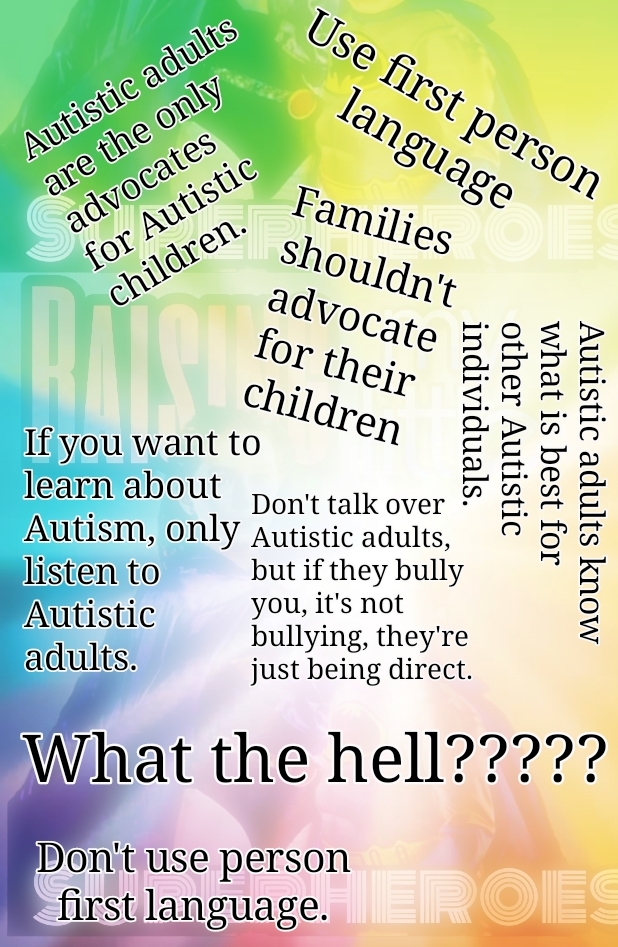
What the hell????


Now this could potentially blow up in my face, but you know what, I'm over people trying to silence others because "I'm Autistic and I know best."

Every time, I'm really not exaggerating, I go onto the various social media platforms, there is yet another post in which Autistic individuals are belittling others, sometimes it is towards neurotypical individuals, other times it is towards Autistic individuals. And the reason is always I'm Autistic and I know best." You know what, I call bs. 

I am Autistic. I have always been Autistic but didn't realise until after both my children were diagnosed as ASD. I always knew that I was different but didn't know how - I didn't fit what some medical professionals say Autism is. After both my children's ASD assessments, (and it was confirmed by those who assessed by children,) I met all of the ASD red flags in my own way.

If I didn’t advocate for both my children, and I will continue to do so until THEY (and no one else,) tell me that they are confident enough to self advocate, who would have advocated for them???

Too often prior to both their diagnosis, and even now years after their diagnosis, medical and education professionals dismissed their struggles because "they don't fit what people think Autism is."

If I didn't advocate for them both, they may not have been accepted into the NDIS. They may not have received the assistance at school. 

Parents do know what is best for their children. Sure listen to Autistic adults, read books - there are some brilliant books out there, - find social media pages to follow - but ultimately take the advice and use it how you want to. Try the suggestions that you read about, if they don't fit you or your child, try something else.

Every Autistic individual is just that, an individual. We share similar traits but that is it. What works for one Autistic individual is not going to work for the next.

One Autistic individuals lived Autistic experience is their experience.

My lived experience as a late diagnosed Autistic adult is my experience. My experience is different, but very similar, to my children's lived experience. My husbands lived experience as a late diagnosed ADHDer, is his experience.

Every Autistic individual, child or adult, is unique.

Instead of telling, no bullying, people into doing what you say because "you know best," interact respectfully and help each other out.

Friday, 1 April 2022

Autism Awareness and Acceptance 2022

It's April, which means it is Autism Awareness Month.

But you know what, we don't need more awareness. Acceptance is what all Autistic individuals want. We want to be accepted for who we are.

April the 2nd is World Autism Day.

Please be accepting of those individuals who are different, regardless of whether you know that they are Autistic or not.

We have been on this journey for almost 10 years, as we knew that L was different from the moment he arrived Earth side. Officially, our families Autism journey began in 2016.

Your view of the world changes when let yourself view the world through another's perspective. Both O and L view the world in their own ways. And we wouldn't have our family any other way!

Throughout the month of April, I am going to share ways in which you can show a little more Autism Acceptance. But acceptance shouldn't just be in April, it should be year round.


[Raising Autism Awareness 101
Autism has no look. Every individual is unique.]

So how can you show more Autism Acceptance?

If an individual tells you that they are Autistic, don't question their diagnosis.

Autism has no look. Too many times, and far too frequently we hear "they just don't look Autistic."

By stating this, or something similar, you are not helping. You are in fact questioning their every being.

It can take families time to actually get an Autism diagnosis, and when you question the validity of the diagnosis, it can be a huge kick in the guts to them.

Don't question, just accept and open your eyes as to how they view the world.


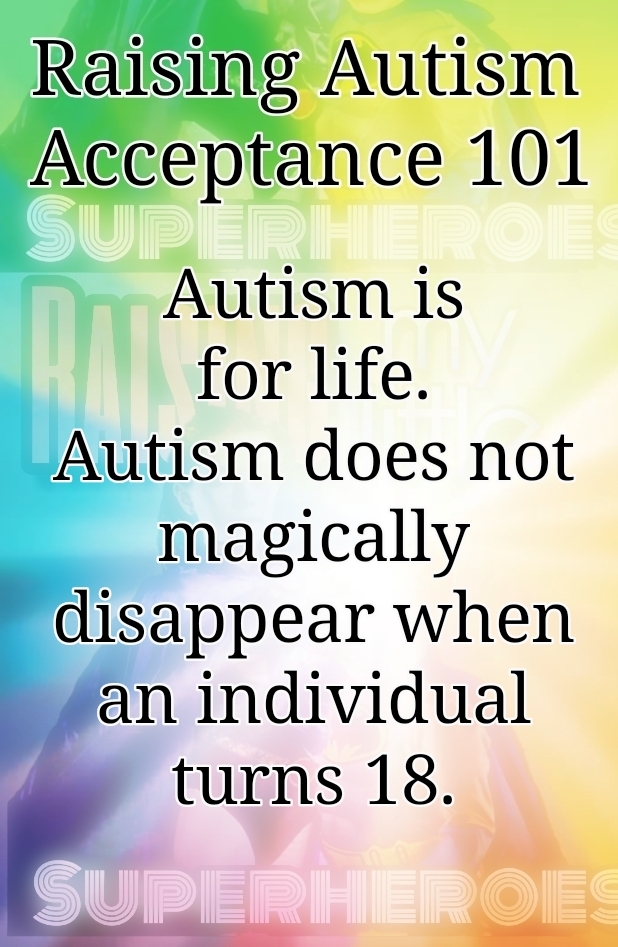
[Raising Autism Awareness 101
Autism is for life. Autism does not magically disappear 
when an individual turns 18.]

Autism is for life. Autism doesn't disappear at the age of 18, but unfortunately therapy services for Autistic adults can be more difficult to find and access. An Autistic individual won't get better, life at times doesn't become easier for the individual.


Saturday, 12 February 2022

Containers for Change

As most of you know, Henry was placed with us in May last year and he has made such a huge positive influence for L, but also for O.

So much that we're going to start fund-raising again, but this time for an Autism Assistance Dog for O.

Rather than use Smart Pups (which are just amazing,) we're hoping to use a different local based organisation that will train O how to be the handler, and the pup at the same time. We're yet to find the perfect puppy, but we're wanting to start the fund-raising journey.

Unfortunately there is no government funding that is allocated to training Assistance Dogs for children, so it's up to the families to raise the money.

The total amount for Henry was close to $35000 - this covered the trainers wages, the training for Henry as well as food, equipment and everything else that he needed, and the costs involved in certification of an Assistance Dog. We're not needing to raise nearly that much for a pup for O, however the cost for Public Access Test is going to be at least $750.

So if you are able to collect cans and plastic bottles, and would like to donate the profits to funds for O's assistance dog, we'd be much appreciative.

We've created a scheme ID with Containers for Change so that if you are able to, the money raised from the cans can be deposited straight into the account for O's pup when you take the containers to the drop off point. This scheme ID is valid in both Queensland and Western Australia.

If you've read this far, thank you so very much ❤

Thursday, 3 February 2022

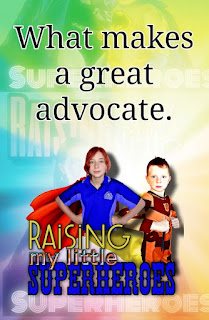
What Makes a Great Advocate?


The moment that we received L's, and then O's, Autism diagnosis, Daddy Superhero and I started on a new journey - becoming advocates for our little superheroes. We could have easily employed the services of an Autism advocate but we know our little superheroes the best.

Being an advocate means that I am assisting my little superheroes to access the services and support that they need both at school and in the community. Until they find their own voices to self advocate, I am their voice.

As I have mentioned in a previous post, being an advocate for my little superheroes is very rewarding but it is also hard work at times. Being an advocate can take you out of your comfort zone if you do not feel confident in speaking up for another person.

Families are generally the best advocates for their children but at times, parents may not physically have the time to attend meetings for their children or they not feel comfortable with the idea of any potential confrontation. If families are also on a learning journey with their children, they may not feel confident in knowing what supports that they should request for their children.

So if you are not confident in being your own or someone else advocate, what qualities should you look for in a great advocate?


Ultimately, advocacy is about speaking on an individuals behalf, and supporting the best interests of an individual while promoting and protecting the individuals rights.

Not all advocates are the same - the role that they play will vary according to any training and study that they have undertaken, their experience in both an advocacy role and with Autism as a whole, and they may have expertise in different areas (education, social, with different disabilities and so on.) 

Anyone can assume the role of an advocate, but the strongest advocates are those who have a direct relationship to those who they are advocating for. That relationship could be that they are a relative of the individual or it could be that they have direct experience with the individuals disability.

In regards to an Autism advocate, the individual should understand and know that Autistic individuals are capable and bring enormous value  to their community. An Autism advocate should know and understand that all Autistic individuals are unique from the next. That the supports that suit one Autistic individual may not suit the next.

A great advocate will want to assist you to become, and assume, the primary advocate role in your child's supports. Through assisting you to advocate for your child, they should provide you with the skills to begin feeling confident to advocate effectively for your child.

They won't make the decisions for you, rather they will assist you to become well informed about your child's needs. They should assist you to consider and weigh up the best options for your child. A great advocate should empower you, and your child, to make the best decisions for your child.

A great advocate should be able to investigate and explore alternative support services for your child. They should be familiar with local therapy services that are available and that would suit your child's needs. They should also be able to point you in the right direction of support services for yourself as a carer.

A great advocate should listen, truly listen, to you and your child about what their needs are, what their goals for the future are and any skills that your child would like to improve on or develop. 

Advocates can be the important link between families and service providers. A great advocate should maintain a professional, respectful and collaborative approach when meeting with yourself and your child, as well as when they are engaging service providers on your behalf. They must be able to communicate with strength and clarity so that needs of your child are met.

When you meet with any potential advocate, you need to feel as though you are connected with them. You will need to have trust and confidence in your chosen advocate that they have your child's needs in mind at all times when they are performing their role. Don't be afraid to meet with several potential advocates prior to engaging them as an advocate.

And above all, trust your gut instinct as sometimes this tells us more about how we feel about some one than any information they give us.

Friday, 12 November 2021

Teach your children to be kind


Teach your children to be kind.

Teach them that differences are what make our world, our communities, society a better place.

Teach them that if they don't have anything nice to say, don't say anything.

Teach them that words hurt. Words stick like cement and they are incredibly hard to remove.

Teach them that just because they are NOT lucky enough to be Autistic, or ADHD, this doesn't make them better, smarter, faster or more intelligent than those who are Autistic or ADHD.

Educate them that without these amazing ADHD and Autistic minds, those Pokemon that they love, may never have been thought up. Those Dogman books that they love reading, may never have been written. That rap artist they listen to, may never have penned those songs. That gymnast who they idolise - ADHD. The list is endless of amazing, talented neurodiverse minds. All of which have made a positive impact on our world.

Why?

Because tonight, this little superhero is asking why him? Why am I Autistic? Why can't I be the same as everyone else? Why do I struggle with things that other kids don't struggle with?

Because if you were the same as everyone else, you wouldn't be you. Because the world needs minds like yours that think way outside of the box on the precipice. Because you were born to be you.

This journey is hard. We take 5 steps forward and then about fifty back. Tomorrow we'll start the journey forward again because we don't give up without a fight.

Sunday, 7 November 2021

A story about a boy named L

 This is a story about a boy named L. Yes, our L.

A boy who at the age of three and a half received an Autism diagnosis, which began a series of changes for him.

Prior to receiving L's Autism diagnosis, life was difficult for L. Whenever we attempted to raise concerns about L and how we thought that he was different from other children his age, our concerns were brushed off by early childhood educators and various medical professionals. We were told that L was just being a boy, that he was just a naughty child, that it was our parenting skills to blame for L's differences and everything in between.

L struggled to maintain friendships with children his age. We regularly heard other parents tell their own children, in ear shot of us, don't play with L because he is a naughty boy.

Then we received L's Autism diagnosis and everything made sense. He made a wonderful friend in Master H. L began early intervention therapy. L started school and he began to hit milestones and overcome obstacles.

When we moved back to Queensland, we made the decision to keep L back in Prep - in effect he would do two years of Prep (the first year of primary school,) as he had already completed the prep equivalent in Western Australia. We've made a few brilliant decisions for L thus far, and going back into Prep was definitely one of them.

He had another year of the foundation skills needed in primary school and has not looked back.

L has overcome many obstacles to get where he is today.


Late Thursday afternoon, one of the Special Education Teachers at school rang me to say that the school had nominated L for a Courage award and were we able to attend the award ceremony on Sunday morning.

The Lions Club gives out Children of Courage awards to children who have shown courage in overcoming challenges that they encounter, achieving goals and so on. The awards were established in 1983 in WA and were introduced to the Bribie District in 2002.

We're so very proud of everything that L has achieved so far and we know that his future is extremely bright.

The Lions Club also gave Henry a Courage award for assisting L on a daily basis ❤❤

By the time the awards were being presented, L had entered into shutdown due to the noise echoing in the hall and the fact that there was a lot of focus on L and the six other children receiving the awards, hence O being in the photos as she was being the amazing big sister that she is in supporting L.


Mrs S just had to have a photo with Henry.


The Lions Club president, Michael, and Mrs Brooke Savage, our local councillor.


Every step so far, L has had us behind him, encouraging him. And we couldn't have done this without the amazing support team around him and us. His therapy team (Tara, Katie, Kira) in Western Australia, the amazing teachers (Mrs S, Mrs A and Mrs S) and support staff (Mrs DS and Mrs S) at the school that he attended in Western Australia. The parents of the children that he formed strong friendships with in Western Australia - you know who you are. The early childhood educators and OSHC staff who not only believed in L's capabilities but also encouraged him to step outside of his comfort zone - Stevie, Sharon, Jess, Katie, Dannii, Alisha, Beth, Kayla, Dan, Emily. Zaim - L's support worker who was just amazing. The teaching staff (Miss L, Miss E, Miss P and Mrs S) and the support staff (Miss K, Miss J, Miss A, Miss B and Mrs H) at his current school as well as all of the staff behind the scenes at school. Thank for believing in L and for encouraging him to reach for the stars.


Saturday, 6 November 2021

O's turn to shine


Both of the little superheroes make us proud every single day, but last month it was O's turn to shine.

This year marked O's first year of high school. We were all a little nervous about high school, O included, but she hit the ground running an has not looked back. In the first few days of the new school year, O came home raving about the new group of friends that she had made - they all shared a love of Anime. There were no nerves at all from O.

Last year, O applied (with the encouragement from us and the teachers at the Primary School) for both of the academies that the high school run alongside their regular classes. One is focused on STEM units and the other is the Academic Academy. O was offered a spot in the STEM academy. And it is exactly where O needs to be.

Every other student in the STEM Academy is like minded, they all love STEM and they want to be at school. O is loving every minute of it.

O's anxiety has tried to get the better of her throughout this year, but O has been determined to not to let her anxiety take over.

Towards the end of last month, we received the news from the school that O was to receive an Academic Excellence Award for her efforts in class. We've always told both little superheroes that grades really don't matter to us, we just want them to put in the most effort that they can into school. And O has done just that.

O, you have put in the effort at school all year and very mush deserve this award. The world is your oyster, we are so very proud of you and can't wait to see what your future holds ❤❤